
Executive Summary
Would you like to earn money by making your flexible devices – e.g. boilers – available for grid operators when you are not using them?
To make it happen, flexibility providers would have to know how many boilers can be activated in the same street without jeopardizing grid integrity. As they currently have no means to know, they have to play it safe resulting in a lot of flexibility that is not put to good use. How could we leverage as much residential flexibility as possible by optimally using the existing grid capacity?
To solve that challenge, Centrica, Elia, Fluvius, N-SIDE and ThermoVault created the use-case SOTERIA.
- End of the ideation Phase: They had defined the hypotheses to be tested in order to validate the feasibility to unlock residential flexibility in a grid secure way
- End of the Sandboxing Phase:
- (1) a design or interface specification that step-by-step describes the required interactions needed between the FSP’s, DSO and TSO.
- (2) a subset of this design was fully implemented in 2 physical locations in the field.
Next steps: With an energy system on the brink of disruption, the Soteria team concludes its work even more convinced that this challenging road ahead is to be tackled by joining the skillset and perspectives of the energy system stakeholders, with a long-term outlook in mind.
Challenge & Opportunity
A major key to the energy transition is making sure devices use energy when it is available: when the sun shines or the wind blows. A lot of flexible devices can be found in every household: by activating, for example, an electric boiler at the right time, a flexibility provider helps the energy system on one hand, and on the other hand, the boiler owner earns some money for that.
There’s one problem, however: Flexibility providers have no means to know how many boilers can be activated in the same street without jeopardizing grid integrity. Therefore they have to play it safe resulting in a lot of flexibility that is not put to good use.
Within the framework of IO.Energy, Centrica, Elia, Fluvius, N-SIDE and ThermoVault summarized the challenge as follow:
How could we leverage as much flexibility from residential assets as possible without endangering the grid?
The Vision
1 | Growth of RES is putting our grids under pressure
Electricity systems in the EU and US are “decarbonizing” rapidly. The integration of intermittent and distributed renewable energy sources is however pressuring our electricity grids.
2 | Demand response is a key enabler of the energy transition
Demand response, is a critical resource for achieving a low carbon, efficient electricity system at a reasonable cost.
3 | But there is a huge potential of unused flexibility at distribution level
But a large part of the available residential flexibility cannot be leveraged towards system operators due to the limited information sharing between the grid operators, flexibility providers and flexible consumers.
4 | Bring more revenue streams to prosumers
Within the IO.Energy Soteria project, Belgian energy leaders will connect all stakeholders to transform uncoordinated activations by residential assets (e.g.DR-ready electric boilers) into grid-secure demand response, maximizing the value for residential electricity consumers and stabilizing the energy system.
The Product & Data Approach
The Soteria project presents a coördination mechanism that allows for the integration of residential flexibility in our power and energy system in a grid secure way.
Our data exchange & coördination mechanism based on IO.E enables:
- More residential consumers to be able to take part in flexibility[1]
- System operators to reduce the cost of managing the power system
By
- Unlocking residential flexibility in a grid secure way
- Increasing residential flexibility offering on FCR/FRR markets
[1] In comparison with current-state conservative allowances based on ‘the circle rule’ or a yearly-worst-case calculation of available grid capacity
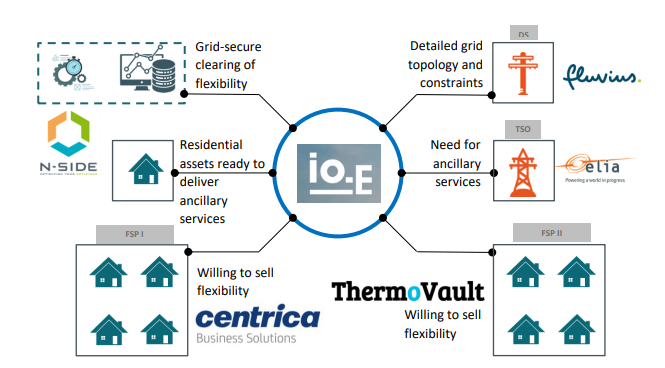
Soteria created a coordination mechanism among stakeholders in the energy sector enabled by an exchange of messages over IO.E. It should therefore not be regarded as an app providing some service or feature to an individual user with a specific profile and a number of needs to be met.
Nevertheless, Soteria offers something that is crucially missing today: a means to coordinate the actions of many stakeholders in the energy system by sending back and forth the information needed to ensure that all parties can organize themselves to strive towards optimal overall system benefits.
Step 0: Share Virtual Power Plant (VPP) information
Step 1: Gather grid insights from devices and digital meters
Step 2: Publish grid bandwidth for flexibility
Step 3: Offer flexibility to market, after which the market clears within the specified grid constraints
Step 4: Cleared market schedule sent for validation to the system operator
Step 5: Schedule approved by grid logic agent
Step 6: Activation of residential flexibility
Step 7: Audit trail & settlement information gathered from digital meters
The scope of the sandboxing phase
During the sandboxing period, the scope of the use-case was further refined to:
| Soteria problem arena | Conceptual design for | MVP build for | |
|---|---|---|---|
| In scope | Explicit flexibility: flex offered on markets by aggregators with centralised control over residential assets | Focus of design of the solution scheme was on ancillary services: FCR, aFRR, mFRR | -Grid-secure integration of residential DR in FCR (day-ahead) -Grid-secure integration of residential DR in aFRR (intra-day) |
| Out of scope | Soteria does not tackle comfort-driven simultaneous group behaviour (e.g. people coming home and plugging in their EV at the same time) | Not in scope but we deem the design expandable to other products: Energy trading, future flex products e.g. communities | Not in scope: mFRR, spot market |
The sandbox results
1 | Where the hypotheses validated?
A. Thanks to an IO.E information exchange process, more customers within a certain geographic area can take part in flexibility mechanisms, in full coherence with the grid.
Validated: Field tests unlock 27 assets and up to 70kW on one single feeder as examples.
_
B. Markets & aggregators can use grid information given up-front and adapt to a set of constraints as a preventive way to avoid grid problems. (as opposed to curative measures to solve problems once they already occur)
Validated: the process was run successfully with a 15-minute takt time.
_
C. A Market clearing algorithm can represent grid-aware flexibility offers in reserve auction platforms, given a set of flexibility bids and grid constraints for Flanders
Partially validated: working algorithm developed and deemed scalable, but not tested at scale.
_
D. We assume the cost of operating the envisioned information exchange is low enough for all parties to consider scaling up
Partially validated: the bottleneck in terms of cost is not on the messaging but significant on the telemetry & measurement cost
2 | What are the lessons learned?
Our main conclusions at the end of this MVP are:
1. That the idea of conceiving and implementing a coördination mechanism over a platform such as IO.E, to optimize towards a social welfare for allocating the available LV grid bandwidth to flexibility, is technically feasible and valuable in terms of capacity unlocked on grids. We have designed and built a fully working version of the interface, leading to actual in-the-field activations using residential boilers.
2. That the costs of scaling a Soteria-style process are limited with respect to the actual messages constituting the process. The bottleneck lies in the cost of acquiring and storing the necessary measurement & telemetry data. Therefore, scaling Soteria will depend on finding an adequate balance between the amount of input data needed and bringing the uncertainty on bandwidths low enough. The faster the marginal cost of measurements decrease, the sooner such a setup becomes realistic at scale
3. That a number of challenges are ahead of us on the market design as well, due to the fact that current energy/flexibility markets were never designed with the idea of incorporating low-level, granular grid constraints. Integrating local grid constraints gives a tendency to chopping up markets geographically, whereas for the sake of liquidity, most (TSO) markets have a tendency towards unified markets of the European continent.
4. That the core question addressed (namely how to leverage residential flexibility, needed to cope with the energy transition, making optimal use of the existing capacity invested into by society) will require intense collaboration between stakeholders involved.
3 | What are the next steps?
With an energy system on the brink of disruption, the Soteria team concludes its work even more convinced that this challenging road ahead is to be tackled by joining the skillset and perspectives of the energy system stakeholders, with a long-term outlook in mind. Together, Soteria’s partners identified 2 main barriers to implement the concept at scale.
1) the availability of LV measurements in order to calculate ‘bandwidths’ on the granularity proposed for Soteria and
2) the integration of these steps into existing market designs and timelines that are often organized on national or even EU level (for which several proposals were identified within Soteria).
While the architecture is sound for the long-term, the first required next step is identifying possible paths forward that gradually grow towards the vision that was presented by the Soteria team.
Members
Ruben Bäumer Restore

Klaas Charlier Thermovault
Bert Claessens Restore

Hannes De Schrijver Fluvius

Maxime Hanot N-Side

Sandro Iacovella Thermovault

Mehdi Madani N-Side

Pol Olivella Rosell Thermovault

Stef Peeters Restore

Adrien Rosen N-Side
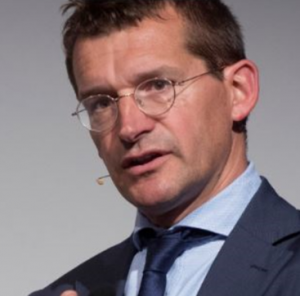
Hans Vandenbroucke Elia
Partners
Elia is the Transmission System Operator of Belgium.

Fluvius is the Distribution System Operator for Flanders, with the mission to sustainably connect society through multi-utility solutions. As founding father of IO.E it will co-create a grid logic agent for IO.E that solution providers can interact with, enabling them to develop new services for customers in coherence with the physical grid. In doing so, IO.E becomes an infrastructure connecting the digital and the physical world.

N-SIDE is an innovative software consulting company in advanced analytics designing artificial intelligence and optimization solutions for Supply Chain, Operations and Energy management.
REstore, part of Centrica Business Solutions is a leading aggregator with a global scope, providing demand response solutions for industrial and residential consumers through our FlexPond platform. REstore operates > 1.5 GW in different flexibility programs, from power to energy products.
ThermoVault offers an all-in retrofit solution that transforms space water heaters into an energy-saving storage device. As well as a certified Ecodesign savings of 12–28%, ThermoVault currently controls more than 1.5MW of residential appliances in Belgium.
