
Context
Many consumers do not feel completely comfortable when they look at their energy consumption. Is their consumption (ab)normal, they often wonder. Most of the time, consumers are unaware of the steps they can take themselves to optimise their use. Saving energy seems to be reserved only for those who with the means to install solar panels or a water pump.
With Maka, we strive to get the consumer back in the driver’s seat to optimize his/her consumption no matter their budget.
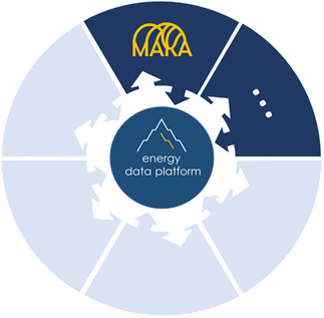
Approach developed during the ideation phase
Maka helps consumers to understand what impact certain behavior, appliances and investments have on their consumption as for most consumers this is unclear. Through an app, it shows to consumers that small, often free interventions can make a difference. Developing the customer awareness is the first steps towards more value for the end consumers such as:
- Becoming more energy efficient: Support consumers to become more energy efficient as a great deal of consumers today are unaware of the steps, they can take in that direction
- Predict the impact: Simulate the consumption and financial impact of investing in solar panels, heath pumps, EV… as due to changes in regulation and tariffs, consumers are becoming more and more hesitant to invest in local production
- Support correct investments: Support consumers in making the right investments based on their consumption profile as the same solution might not be the right fit for everyone
To that end, Maka wants to build and leverage the power of an energy consumer community with the ambition to be the number one platform around energy consumption. Similar apps flourish in different domains, where users stimulate and encourage each other with tips.
Furthermore, to gain access to services, people are willing to share their (personal) data, such as their location or other demographics. These are valuable for companies, in order to tailor their offerings better to their users.
Objectives
1 | Free of charge
The platform will be easily accessible and will be available, completely free of charge to address a large community without any obligations. A large group of motivated users will enable the platform to offer personal benchmarking.
2 | Benchmark your consumption
This personal benchmark gives the consumer a tool to investigate his own use. The more information he shares about his household situation, the more accurate the findings are.
3 |Community support
In addition, the platform also offers the opportunity to evaluate the community itself. Similar households are matched to each other, in order to share mutual findings and to learn from each other which daily changes made an impact on their energy bill. Chat functions make it possible to offer each other social support.
The platform also offers some added services to further support customers in their energy efficiency through online personal coaching.
What are the use-cases results? Have the hypotheses been validated?
Maka, the application that puts the energy-conscious consumer back in the driver’s seat no matter their budget. To make that vision happen, Maka tested 2 key hypotheses during the sandbox phase:
1 | Technical feasibility to extract data from the P1 port of consumers, transfer them via the IO.E Platform and store them on the energy data platform. Dongles were installed at a small batch of test users to be able to validate the technical feasibility.
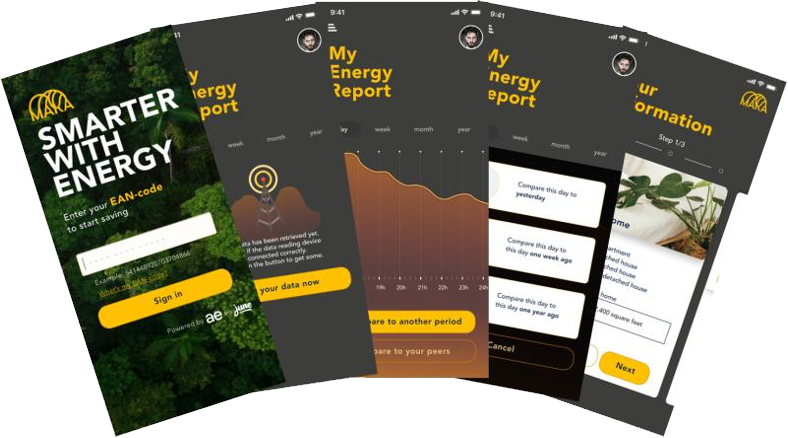
2 | The market traction to test the added value of services provided and the willingness to share private data, Maka developed a frontend B2C application with 3 features enabling consumers to gain insights into their profile:
- Monitoring: basic features that shows data collected from the digital meter on a quarterly basis
- Personal benchmarking: feature that allows for comparison of consumption and injection on a daily, weekly, monthly and yearly basis
- Community benchmarking: (partly delivered) feature that allows for comparison of personal consumption profile with relevant profiles between peer groups
What are the lessons learned?
Maka has validated the technical feasibility to extract, transfer and store the data.
They have faced 2 major challenges to validate the market traction:
- It has been very challenging for Maka to connect enough customers to their platform to get representative insights.
- The financial bottleneck is the price of installation of a dongle connected to the P1 exit on the digital meter, necessary to collect the consumer data.
What are the next steps?
For Maka: Find a walk around to extend the pilot to a larger consumer base. To that end, Maka would like to expand the consortium to new partners. Feel free to apply if you can contribute!
For the ecosystem: Make the installation of dongles possible in a cost efficient way for the consumers and services providers.
Members

Philippe De Croock AE

Kathleen Demol AE

Niels Nuyttens AE

Charles Van Goidsenhove AE

Arnout Vanden Berghe AE
Partners
AE
